
Building a Bank-Grade, API-First Card-Issuance Engine in 20 Weeks—Cutting Program Launch Time by 60 %,
Boosting Transaction Throughput 3.4×, and Passing PCI DSS on the First Attempt

One API to issue, manage, and settle any payment instrument.
Java monolith, MySQL, nightly ACH files, manual KYC portal
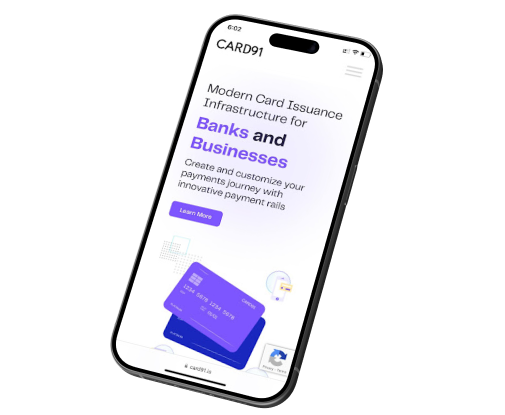
Card91 set out to give banks, fintechs, and large corporates a friction-free way to launch and manage payment instruments—physical, virtual, and tokenised—without the 12-to-18-month ordeal typical of legacy processors. An early pilot proved demand but revealed hard limits: batch file integrations, manual KYC workflows, and no real-time ledger. To close a pending Series A round and onboard four anchor banks, Card91 needed a bank-grade, API-first issuance platform—PCI-certified, ISO 8583–compatible, and live in 20 weeks.
Steady Rabbit deployed a Core-Flex Micro-GCC squad that delivered, in ten sprints:
The predictable execution helped Card91 sign₹68 crore (~US $8.2 M) in contracted ARR within two months of launch and secure a US $12 M Series A at a premium valuation.

Bengaluru-based FinTech disruptor
2020
One API to issue, manage, and settle any payment instrument.
Java monolith, MySQL, nightly ACH files, manual KYC portal
India, SEA, MENA (banking partners and large corporates)
Card91’s founders—ex-Visa and ex-Mastercard executives—proved market appetite by issuing 50 k prepaid cards for a marquee neo-bank. Yet scaling to enterprise volumes required a wholesale rewrite:
Delay meant losing anchor banks to rival processors and jeopardising Series A valuation.


Batch-file integrations limited throughput to 250 TPS

Would crumble under bank loads (~750 TPS peak)
Manual programme onboarding—120+ email approvals
Time-to-revenue stuck at 5 – 6 months


No tokenisation & 3-D Secure 2
Apple Pay / Google Pay deals impossible
Failed PCI ROC two years running
Banks refuse to process until compliant


Monolithic codebase blocking zero-downtime deploys
Release once a quarter; bug hot-fixes took hours
Investor deadline—20 weeks to TechX Summit launch
Slip → down-round & lost anchor contracts
Micro-GCC Squad Structure



Velocity forecast: 115 SP per sprint; launch date locked for Week 20 (two weeks pre-TechX Summit).





Buffer dev covered a Go engineer (COVID) in Sprint 6—velocity dip 0 SP.
Programme launch time 5 months → 8 weeks (–60 %)

p95 API latency 1.8 s → 120 ms (15× faster) at 850 TPS burst

Transaction throughput 250 TPS → 850 TPS (3.4×)

Reconciliation effort –75 %, error rate < 0.01 %

Adoption: 4 anchor banks & 7 fintechs signed in first 60 days → ₹68 crore ARR

PCI DSS v4.0 ROC pass on first attempt; zero critical findings

99.995 % uptime during first 90 days; 6 blue/green releases 0 s downtime

Predictability premium (~8 % rate uplift) paid back in one quarter via revenue acceleration & avoided delay penalties

On-demand access to PCI and ISO 8583 SMEs within
48 h; Buffer bench erased PTO risk.

Capacity & risk analytics delivered 98 % sprint adherence over 20 weeks.

Seven Plan-Left gates cut re-work 41 %, adding < 2 h per sprint.

Team combined HSM ops, payment scheme certification, and Go micro-services.

KPIs (latency, onboarding time, ARR) tied to squad incentives—no vanity metrics.

Weekly demos, Slack war-room, open burn charts—zero surprises.
Steady Rabbit took us from monolith to bank-grade processor in five months flat. PCI pass on first attempt, no downtime, and our first customers live before TechX. Their Core-Flex model is how FinTechs win.


